About Mercury
Mercury is the closest planet to the Sun and is known for its extreme temperature variations. It has a thin atmosphere and a heavily cratered surface, similar to the Moon. Despite its harsh conditions, scientists continue to study this intriguing planet.
Closest Planet to the Sun: Mercury is the closest planet to the Sun, orbiting at an average distance of approximately 36 million miles (58 million kilometers). This proximity to the Sun means that it experiences extreme temperature variations, with surface temperatures ranging from scorching hot to frigid cold.
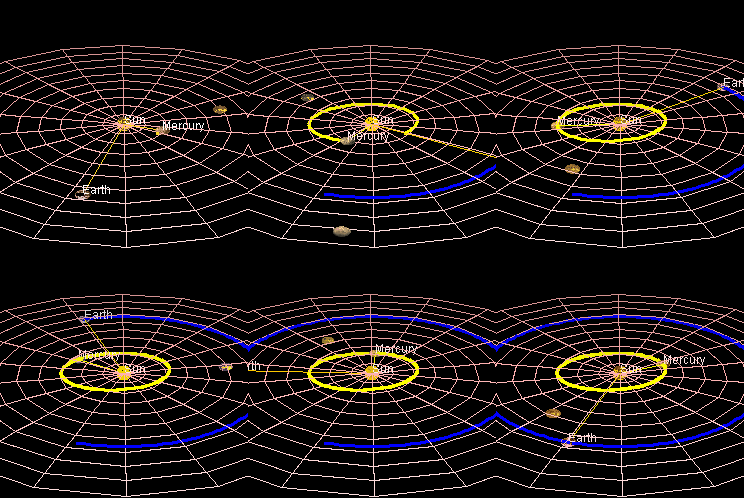
Small and Rocky: Mercury is classified as a terrestrial planet, along with Venus, Earth, and Mars. It is one of the smallest planets in our solar system, with a diameter of about 4,880 kilometers (3,032 miles), which is roughly 38% the size of Earth.
No Atmosphere: Mercury has a very thin and tenuous atmosphere, which consists mainly of trace amounts of hydrogen, helium, and oxygen. Due to its weak gravity and proximity to the Sun, it is unable to retain a substantial atmosphere, making it inhospitable for human life.
Extreme Temperatures : Because of its lack of atmosphere, Mercury experiences extreme temperature fluctuations. Daytime temperatures can soar to around 430 degrees Celsius (800 degrees Fahrenheit), while nighttime temperatures plummet to about -180 degrees Celsius (-290 degrees Fahrenheit).
Slow Rotation: Mercury has an unusual rotation pattern. It rotates on its axis very slowly, taking approximately 59 Earth days to complete one rotation. However, it has a much faster orbital speed, completing an orbit around the Sun in about 88 Earth days. This means that a day on Mercury (one rotation) is longer than its year (one orbit around the Sun).
Heavily Cratered Surface: Mercury's surface is heavily cratered and resembles the Moon's surface in many ways. These craters are the result of impacts from asteroids and comets over billions of years. Some of the largest craters have been named after famous artists, writers, and musicians.
Basin: One of the most prominent features on Mercury is the Caloris Basin, a large impact crater approximately 1,550 kilometers (960 miles) in diameter. It is one of the largest impact basins in the solar system and was formed billions of years ago.
Water Ice in Polar Craters: Despite its scorching temperatures, Mercury's polar regions contain water ice. These areas are permanently shadowed, protecting the ice from the Sun's heat. Scientists believe that the ice may have been delivered by comets or formed through chemical processes on the planet's surface.
NASA Missions: Several space missions have been sent to study Mercury, including Mariner 10, which provided the first close-up images of the planet in the 1970s, and more recently, the MESSENGER mission, which orbited Mercury from 2011 to 2015 and provided valuable data about its geology, surface composition, and magnetic field.
Unexplored Mysteries Despite the advancements in our understanding of Mercury, many mysteries remain. Scientists continue to study this intriguing planet to learn more about its geological history, magnetic field, and the origins of its water ice.